
How we source every claim
Scam Autopsy asks to be trusted about other people’s money. That sets the standard. Nothing goes on screen without a primary source and a locator — the page or the paragraph where anyone can check it for themselves.
This page exists so you do not have to take that on faith. It sets out where the material comes from, what we refuse to put on screen, what is made with AI and disclosed as such, and what happens when we get something wrong.
The rule
No source, no locator, no line in the script
A claim that cannot be traced to a document does not get softened, hedged, or attributed to “reports”. It comes out.
The fact table
Every episode begins as a table, not a script. Each row holds one claim that will be spoken on screen, the primary document it comes from, and the locator inside that document — the page, the paragraph, or the numbered count of an indictment.
A row is marked verified only when someone has opened the document and read the line. The script is then written from the verified table. Never the other way round — we do not write a sentence first and go looking for something that will carry it.
The table survives the edit. When a viewer, a journalist or a consumer-protection office asks where a number came from, the answer already exists and takes about a minute to produce.
| Claim as spoken | Primary source | Document | Status |
|---|---|---|---|
| Claim as spokenTen wire transfers totalling $47.1 million left the bank.Episode 01 | Primary sourceU.S. Department of JusticeFormer executive pleads guilty after losing bank's $47.1 million in crypto scheme | DocumentU.S. Attorney's Office, District of Kansas — press release | Verified |
| Claim as spokenThe sentence imposed was 24 years and 5 months in federal prison.Episode 01 | Primary sourceU.S. Department of JusticeFormer CEO of failed bank sentenced to prison | DocumentU.S. Attorney's Office, District of Kansas — press release, 19 Aug 202419 Aug 2024 | Verified |
| Claim as spokenHeartland Tri-State Bank, Elkhart, Kansas was closed.Episode 01 | Primary sourceFDICHeartland Tri-State Bank, Elkhart, Kansas — closure (PR-58-2023) | DocumentFDIC PR-58-2023 | Verified |
| Claim as spokenA small withdrawal may be allowed to build confidence before a larger deposit.Episode 01 | Primary sourceFinCENAlert on Pig Butchering Scams (FIN-2023-Alert005) | DocumentFinCEN FIN-2023-Alert005 | Verified |
| Claim as spokenEight defendants were charged in a nationwide grandparent-scam network.Episode 02 | Primary sourceU.S. Department of JusticeEight indicted in nationwide grandparent fraud scam | DocumentU.S. Attorney's Office, S.D. Cal. — press release · docket 21cr2216-CAB25 Aug 2021 | Verified |
| Claim as spokenThree defendants were found guilty at federal trial of laundering gift cards bought by fraud victims.Episode 03 | Primary sourceU.S. Department of JusticeLos Angeles County trio found guilty of laundering Target gift cards | DocumentU.S. Attorney's Office, C.D. Cal. — press release, 26 Sep 202326 Sep 2023 | Verified |
| Claim as spokenA demand to be paid in gift cards is, on its own, a scam.Episode 03 | Primary sourceFTCData Spotlight: Scammers increasingly demand payment by gift card | DocumentFTC Data Spotlight, Oct 2018Oct 2018 | Verified |
Extract from published episodes, shown at document level. The working pack carries the page or paragraph inside each document, and the date the row was checked. Rows that fail the check are cut from the script rather than rewritten to survive it.

Adjudicated cases only
We build episodes from cases that have already been through a court, or from findings published by a federal agency or regulator. Court filings. Indictments. Plea agreements. Sentencing releases. Agency alerts and reports from the Department of Justice, the FBI’s Internet Crime Complaint Center, the FTC, FinCEN, the FDIC and the Federal Reserve Office of Inspector General.
We never allege wrongdoing by any living person or company outside a documented adjudication. There is no exception to this for a good story.
Quoted messages come verbatim from the filings, and they are attributed on screen as they are spoken — “per the indictment”. We do not write dialogue for criminals. We do not tighten a quote to make it land harder. If the record is thin in a place, the episode says so rather than filling the gap.
- Episode 01
U.S. v. Shan Hanes · Heartland Tri-State Bank, Elkhart, Kansas
11 primary sources on file
- Episode 02
U.S. v. Ingram et al., 21cr2216-CAB (S.D. Cal.)
7 primary sources on file
- Episode 03
U.S. v. Bai, Hu & Shi — the “Magic Lamp” case (C.D. Cal.)
8 primary sources on file
Recreations, not reenactments
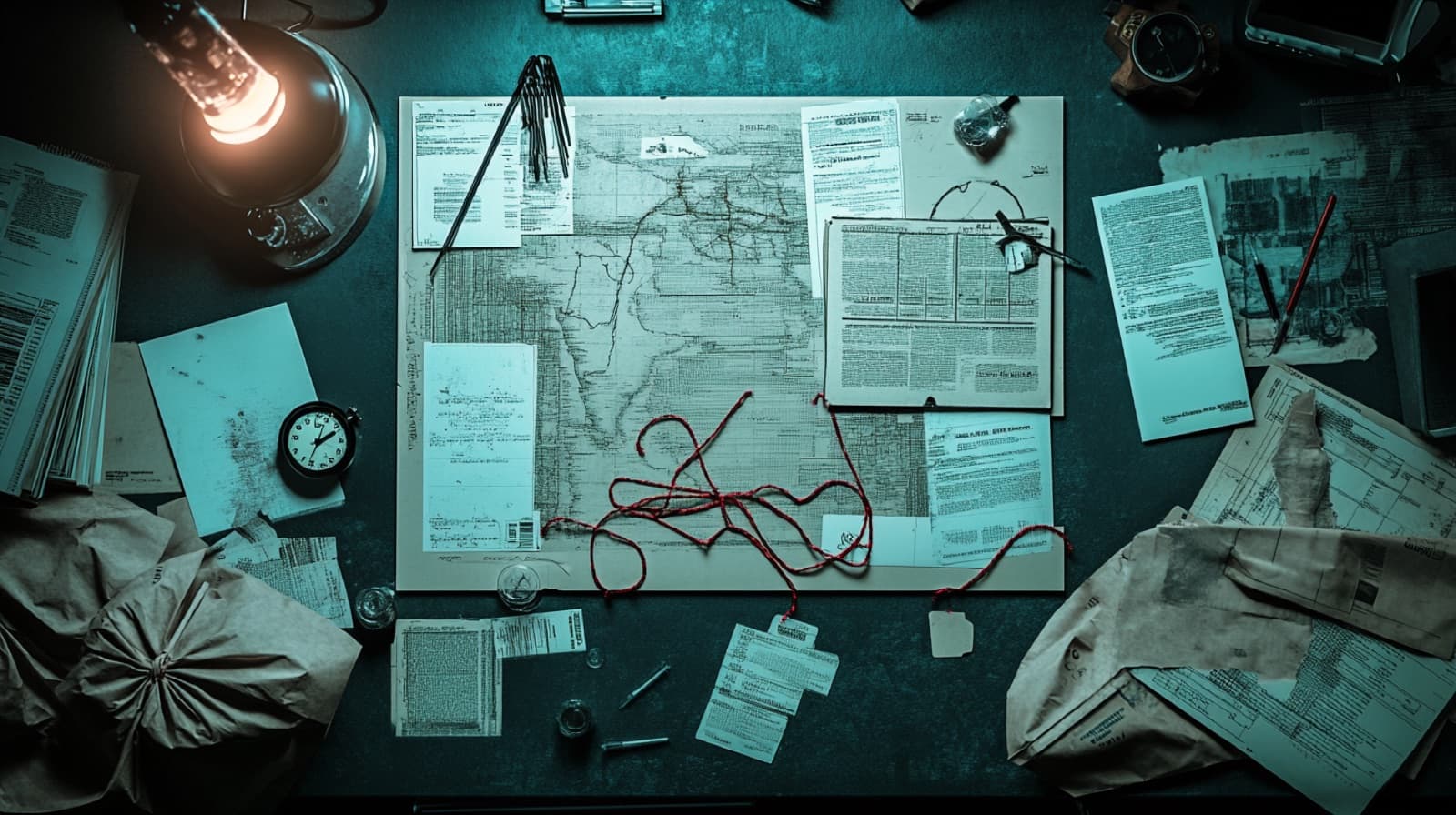
There are no actors in this series. Nobody is hired to cry into a telephone. The visual world is an evidence board: the documents are the hero images — the press release, the docket, the material loss review, photographed on the table under one light.
Where an illustration is needed, it is visibly an illustration. There is no photoreal depiction of any real person, victim or defendant, at any point.
Phone screens and message threads are labelled on screen as recreations of patterns documented in federal filings. The wording follows the filing. The screen around it is ours, and it is labelled as ours.
What is made with AI
Stated plainly, because a disclosure that has to be decoded is not a disclosure.
- Narration
A synthetic voice, disclosed
The narrator you hear is a synthetic AI voice. It is not a person's voice being cloned and passed off as real, and it is not an impersonation of anyone. No voice in any episode is presented as a recording of a real person unless it is quoted material identified on screen.
- Illustrations
Some board art is AI-generated
Some of the objects and textures on the evidence board are AI-generated images. They are used as illustrations and they look like illustrations. They are never used to depict a real person, a real document, or a real place, and they are never presented as photographic evidence.
- Scripts
Written by a person, from the table
Scripts are human-authored from the verified fact table, and the edit history is kept. No episode is generated from a prompt and read out. The judgement about what a document does and does not support is made by a person who read the document.
Narration uses a synthetic AI voice; some illustrations on the evidence board are AI-generated and are visibly illustrations. Disclosed per EU AI Act Article 50. Every factual claim is sourced from public court records and official releases.
That paragraph appears in every episode description, in the footer of every page on this site, and in the material we send to organisations. It is the disclosure required by Article 50 of the EU AI Act, which obliges anyone deploying synthetic audio, image or video content to make that plain to the people receiving it.
Every upload also carries YouTube’s altered-content disclosure, set in the video’s own settings, so the platform shows viewers its label as well as ours. We would rather over-disclose than have a viewer discover it later and wonder what else was not said.
What we get wrong
Sooner or later this series will get something wrong. Assuming otherwise is how outlets end up defending mistakes instead of fixing them.
When it happens, the correction goes on the episode page it affects, dated, saying what the claim was, what it should have been, and which document settled it. We do not quietly edit a line and move on. If the error is in the video itself, the correction also goes in the video description.
Anyone can trigger that process. You do not need to be a lawyer or an agency to be taken seriously.
Report a factual error
hello@scamautopsy.orgTell us the episode, the timestamp where the claim appears, and what you believe the record actually says. We check it against the pack and reply either way — including when the pack holds and nothing changes.
- Corrections are published on the page, not buried in a comment.
- Every correction says what changed and when.
- Nothing is silently deleted.
Most people arrive at this material because something has already happened — to them, or to a parent. They are making decisions about their own money, sometimes within the hour. Content like that has to be right, and it has to be checkable by someone who has no reason to trust us yet. Rigour here is not a style. It is the product.
Primary sources
These are the bodies whose published records the episodes are built on. Each link goes to a document actually cited in a published episode.
- U.S. Department of JusticeIndictments, pleas, sentencings
- FBI IC3Internet Crime Reports
- FTCData Spotlights, Consumer Sentinel
- FinCENFinancial-crime alerts
- FDICBank closures
- Federal Reserve OIGMaterial loss reviews
- UNODCOrganised crime research
- UN OHCHRTrafficking findings
Linking to a public record is not a claim of endorsement, partnership or review by any of these bodies.